

In today’s competitive world, earning a BBA (Bachelor of Business Administration) degree is just the first step. Many students graduate with excellent marks, yet only a few truly stand out in the job market or achieve remarkable career growth. So, what separates the high achievers from the average graduates? The answer lies in key business skills.
These skills don’t just improve your performance in college they prepare you for the real world Experience Mastering them makes BBA students not only employable but highly desirable to recruiters. Let’s explore the TOP 5 business skills every BBA student should develop.
1. Effective Communication Skills
Communication is the backbone of every business interaction. A BBA student may have excellent academic knowledge, but without the ability to communicate ideas clearly, even the best strategies can fail.
Why it matters:
- Clear communication improves teamwork.
- Influences your ability to present ideas convincingly.
- Essential for interviews, client interactions, and leadership roles and many more thing.
How to develop:
- Practice public speaking and presentations in front of your friends.
- Write regularly reports, summaries, or blogs
- Engage in debates and group discussions with your friends.
- Learn to listen actively and understand different perspectives.
Real-world impact: Employers highly value candidates who can articulate ideas clearly. In client-facing roles, your ability to communicate can directly influence business success.
2. Analytical & Problem-Solving Skills
Every business faces challenges, and companies need employees who can analyze situations and solve problems efficiently. Analytical skills and communication skill help students understand complex business scenarios, identify opportunities, and propose solutions.
Why it matters:
- Helps in decision-making and strategic planning.
- Boosts your ability to understand financial reports, market trends, and consumer behavior.
- Critical for roles in management, consulting, and finance.
How to develop:
- Practice case studies related to business problems.
- Use digital analytics and visualization tools like Power BI, QlikView, or Python libraries for data-driven insights.
- Engage in strategic games or simulations that mimic business challenges.
Real-world impact: A student who can analyze a problem, interpret data, and suggest actionable solutions is a valuable asset for any organization.
3. Leadership and Team Management Skills
BBA students who can lead teams, motivate peers, and handle responsibilities effectively often stand out in the professional world. Leadership is not just about managing a team it’s about inspiring, guiding, and taking ownership.
Why it matters:
- Most businesses and companies prefer candidates who can work in teams and lead projects.
- Leadership experience increases employability and career growth potential.
- Demonstrates confidence, accountability, and strategic thinking.
How to develop:
- Take leadership roles in college clubs, events, or societies.
- Lead group projects or initiatives.
- Take on internship roles that involve project management or team coordination responsibilities.
- Learn conflict resolution and negotiation skills.
Real-world impact: Recruiters look for leadership qualities when hiring for managerial roles. A student who can guide a team is often considered for higher responsibilities early in their career.
4. Digital and Technological Skills
In the modern business environment, digital literacy is no longer optional. Every industry from marketing to finance is increasingly dependent on technology. BBA students who are digitally proficient have a significant advantage.
Why it matters:
- Enhances efficiency and productivity.
- Improves your ability to analyze digital data and market trends.
- Makes you adaptable in a tech-driven business environment.
How to develop:
- Learn Microsoft Excel, PowerPoint, and Word to perfection.
- Explore digital marketing tools like SEO, Google Ads, and social media analytics.
- Understand basics of business analytics software like Tableau, SPSS, or ERP tools.
- Keep updated with emerging technologies like AI, blockchain, and automation in business.
Real-world impact: Companies look for candidates who can leverage technology to solve problems and drive business growth. BBA students with digital skills are often preferred for analytical and managerial roles.
5. Networking and Relationship-Building Skills
No matter how skilled you are, building strong professional relationships can open doors to opportunities that degrees alone cannot provide. Networking is not just meeting people it’s about creating meaningful connections.
Why it matters:
- Helps in finding internships, mentorships, and job opportunities.
- Builds professional reputation and credibility.
- Enhances collaboration and business partnerships in the future.
How to develop:
- Attend seminars, webinars, and business conferences.
- Join professional platforms like LinkedIn and connect with industry experts.
- Participate in college events and alumni networking opportunities.
- Learn to communicate politely, follow up, and maintain relationships over time.
Real-world impact: Many successful careers are built on strong networks. A BBA student who knows how to connect with the right people often accesses better opportunities faster.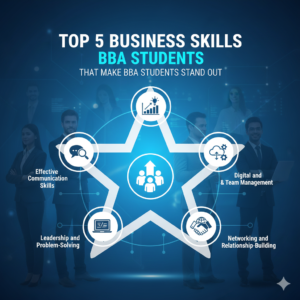
Conclusion
Standing out as a BBA student requires more than academic excellence. Mastering communication, analytical thinking, leadership, digital proficiency, and networking skills sets you apart from your peers. These five skills not only make you employable but also prepare you to excel in real-world business environments.
By investing time and effort into these areas, BBA students can transform themselves into confident, capable, and highly sought-after professionals. Remember, in the business world, skills matter as much as degrees and these five will give you a head start.
FAQs
1. What skills make a BBA student stand out?
Communication, analytical thinking, leadership, digital proficiency, and networking.
2. How can I improve communication skills?
Practice speaking, participate in discussions, and write regularly.
3. Which tools help develop analytical skills?
Use Power BI, QlikView, Python, Excel, or Google Data Studio.
4. Why is networking important for BBA students?
It opens doors to internships, mentorships, and job opportunities.
5. Can internships enhance leadership skills?
Yes, managing projects or coordinating teams provides real-world leadership experience.
6. Are digital skills necessary for a BBA graduate?
Absolutely, they increase employability and adaptability in today’s tech-driven business world.