
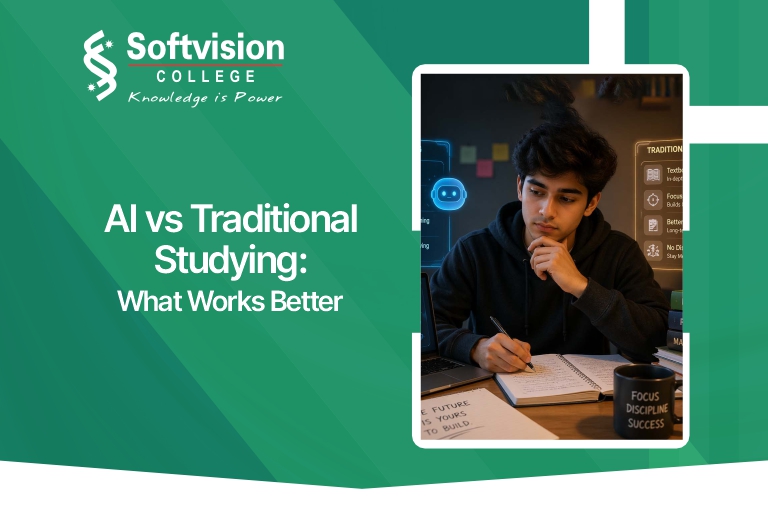
Introduction: A New Era of Learning
Walk into any classroom or open any student’s laptop and you’ll see a shift. From handwritten notes to AI-generated summaries, the way students learn has changed dramatically. Tools powered by artificial intelligence are now assisting with research, writing, problem-solving, and even exam preparation.
But here’s the real question: Is AI actually better than traditional studying, or are we losing something essential?
The reality goes beyond choosing one side. In fact, the smartest students in 2026 are doing something different they’re combining both.
Quick Overview
In 2026, students are no longer choosing between AI and traditional studying they’re navigating a blended learning world. AI tools offer speed, personalization, and accessibility, while traditional methods build deep thinking, discipline, and long-term retention. The real advantage lies in understanding when to use each approach and how to combine them effectively.
What is AI-Based Studying?
AI-based studying refers to using intelligent tools and platforms that adapt to your learning needs. These tools analyze your behavior, track progress, and offer personalized recommendations.
Examples include:
- AI-powered note summarizers
- Adaptive learning platforms
- Chat-based tutors
- Automated flashcards and quizzes
- Voice-assisted learning apps
Platforms influenced by companies like Google and OpenAI have made these tools more accessible than ever.
What is Traditional Studying?

Traditional studying includes methods that have stood the test of time:
- Reading textbooks
- Writing notes by hand
- Classroom lectures
- Group discussions
- Self-practice and revision
These methods may seem old-school, but they play a critical role in building foundational knowledge and cognitive skills.
AI vs Traditional Studying: A Detailed Comparison
Let’s break down how both approaches compare across key areas.
| Factor | AI Studying | Traditional Studying |
| Speed | Fast, instant answers | Slower, requires effort |
| Personalization | Highly adaptive | Limited |
| Understanding | Can be surface-level | Deep and conceptual |
| Engagement | Interactive and dynamic | Depends on teaching style |
| Retention | May be lower if overused | Strong long-term memory |
| Accessibility | Available anytime, anywhere | Limited to resources and schedule |
| Skill Development | Tech and research skills | Critical thinking and discipline |
What Research Says
According to UNESCO, AI in education can significantly improve learning outcomes when used responsibly, especially in personalized learning environments.
Studies indexed in the National Institutes of Health (NIH) database show that active recall, or retrieval practice, is significantly more effective than passive review methods like rereading. Research also suggests that deeper engagement methods, such as writing notes or self-testing, can improve understanding and long-term retention.
This means both approaches have scientifically proven benefits but in different ways.
Where AI Studying Wins

1. Personalized Learning Experience
AI tools adjust based on your strengths and weaknesses. If you’re struggling with a concept, the system adapts instantly.
2. Time Efficiency
Need a summary of a 50-page chapter? AI can do it in seconds saving hours.
3. 24/7 Availability
Unlike teachers or tutors, AI never sleeps. You can study anytime.
4. Interactive Learning
Gamified quizzes, voice assistants, and instant feedback make studying less boring.
Where Traditional Studying Still Dominates
1. Deep Understanding
Reading, writing, and reflecting help you truly grasp concepts not just memorize them.
2. Critical Thinking Skills
Traditional methods force you to think, analyze, and solve problems independently.
3. Better Memory Retention
Writing notes by hand has been proven to improve recall and comprehension.
4. Discipline and Focus
Without shortcuts, students develop consistency and mental endurance.
The Real Winner: Hybrid Learning
Here’s the truth AI vs traditional studying is the wrong debate.
The real advantage lies in combining both.
Example of a Smart Study Approach:
- Use AI to understand a topic quickly
- Switch to traditional methods to practice and retain
- Use AI again for revision and testing
This balanced strategy ensures efficiency without sacrificing depth.
In many modern institutions, including emerging models at places like Softvision College, educators are subtly encouraging this blend because it mirrors how real-world learning works today.
Real-Life Study Scenario: How Top Students Use Both
Imagine two students preparing for the same exam.
- One relies only on AI quick summaries, instant answers, minimal effort
- The other spends hours reading textbooks without any smart tools
Now, consider a third student.
They use AI to break down complex topics in minutes, then switch to traditional methods to write notes, solve problems, and revise actively.
By exam time, this student doesn’t just remember they understand.
This is exactly how high-performing students in the best college environments are studying in 2026. They don’t choose sides they build systems.
Practical Tips for Students in 2026

1. Don’t Rely Entirely on AI
AI helps, but you must think.
2. Use AI for Clarity, Not Dependency
Ask AI to explain but try solving problems yourself afterward.
3. Keep Writing Notes
Even in a digital world, handwritten notes still matter.
4. Practice Active Recall
Close your notes and test yourself. This builds memory.
5. Limit Screen Overload
Too much digital learning can reduce focus and retention.
Common Mistakes Students Are Making
- Copy-pasting AI answers without understanding
- Skipping textbooks entirely
- Overusing shortcuts instead of practicing
- Ignoring foundational concepts
These habits may help in the short term but they weaken long-term learning.
Future of Studying: What’s Coming Next?
By 2030, we can expect:
- AI tutors with emotional intelligence
- Fully immersive VR classrooms
- Brain-based learning analytics
- Hyper-personalized education paths
But even then, the basics reading, writing, thinking won’t disappear.
FAQs
1. Is AI better than traditional studying?
Not entirely. AI is faster and more convenient, but traditional studying builds deeper understanding and memory. The best approach is combining both.
2. Can students rely completely on AI tools?
No. Over-reliance on AI can weaken critical thinking and problem-solving skills.
3. Does handwriting notes still matter in 2026?
Yes. Research shows handwritten notes improve retention and comprehension.
4. How can I balance AI and traditional studying?
Use AI for quick explanations and summaries, then switch to traditional methods for practice and revision.
5. Are colleges encouraging AI-based learning?
Yes, many modern institutions are integrating AI tools, but they still emphasize core learning methods.
Final Thoughts
In 2026, learning isn’t about choosing sides it’s about making smarter choices.
AI gives you speed.
Traditional studying gives you strength.
When you combine both, you create a powerful system that not only helps you score better but also prepares you for real-world challenges.
And in a world that’s changing this fast, that balance might just be your biggest advantage.